- Loan requests using the word "payday" still seem to be a bad option.
- None of the worst-performing words are used more than a handful of times. The most frequent word in the group, "restaurant", was used in only 0.22% of successfully created loans. Given these small numbers, it's entirely possible that the worst performing words are only that way due to dumb luck. But, given that words like payday seem to have low payout rates both across the years and at other P2P lending sites (my original list of low-paid words at Lending Club) I'm not convinced that this is sheer randomness.
- A few of the worst-performing words seem to have performed poorly year-after-year: "franchise", "operate", "tools", "sincerely", in addition to the aforementioned "payday", and "restaurant".
- None of the most frequently used words really seem to stand out as paying back above or below the average.
Showing posts with label Lending Club. Show all posts
Showing posts with label Lending Club. Show all posts
Thursday, September 27, 2012
Initial Thoughts on Words in Lending Club Loans
Now that we have an easy way to see statistics for word use in loans on Lending Club it's interesting to see what we can find. A few of the interesting things that I've noticed:

Sunday, September 16, 2012
Index Page and Search Added to Word Analysis Pages
I'm thrilled to see all of the interest in my word analysis. I've just added an index page to the site. Two big things here: a new search box to more easily get to the pages and three 20-word lists covering words with the best payback rate, worst payback rate and most common words used by borrowers.
More changes to come.
More changes to come.
Friday, September 14, 2012
Words with Lends
Today I'm pleased to announce an early version of some word-use analysis pages that I've created for all of the loans successfully funded on Lending Club.
For all words used 50 or more times in the loan title and description I've created a page at http://shoofile.com/loanwords/lendingclub/<word>.html where visitors can find out more information about loans that contain that word.
Here are some examples that I've covered on the blog previously:
For all words used 50 or more times in the loan title and description I've created a page at http://shoofile.com/loanwords/lendingclub/<word>.html where visitors can find out more information about loans that contain that word.
Here are some examples that I've covered on the blog previously:
Also I've added a special "word" for when the Loan Description is blank:
For any word that you'd like to test, you can do so by editing the URL to replace "<word>.html" with whichever word you're curious about.
There are over 2500 words used on Lending Club more than 50 times. For any that aren't used that often you'll get a Not Found error when you look for them.
If this proves popular enough, I'll keep improving the interface to add features like a summary page of the most-used words and a search-box to make finding words easier. I'll also add more details on how I've done the calculations, so that anyone interested can replicate my numbers.
For each topic, a loan is considered to have the word if it appears in the description or subject once or more. I am counting unique loans, so if the borrower wrote the word multiple times, the loan will still count only once. Here's what you get on each report:
- The number of loans using the word per year.
- The percent of loans in currently in each status by year.
- The average grade of all loans containing the word.
- Comparison charts, showing the average payback rate for each loan letter compared to the average payback rate of loans with this word.
For these charts I defined payback rate as: (Paid, Current loans) / (All Loans Except for those with the status Issued)
Update, Sept. 16: I have added an index page to the site here.
Update, Sept. 16: I have added an index page to the site here.
Friday, July 13, 2012
LendStats Filters Down
Bummer. From KenL, creator of LendStats:
and
It's too bad. LendStats has been a great resource for the community and helped me, personally, with my returns on Prosper and LendingClub. Additionally, LendStats has one of the best P2P forums on the net--with participants who are genuinely thoughtful and helpful.
Ken, thank you for all of the work you've put into LendStats. I have certainly appreciated it. I'm sad to see the feature go, but I certainly understand the desire to move on. Good luck in whatever you choose to focus on next!
My original goals with LendStats were to find out what the real returns were and to figure out how p2p lending could be profitable for lenders (remember people... there was a time when p2p lending was not profitable for lenders). Both of those goals and a whole lot more have been accomplished. So I feel no urgency to get the filters up and running again. Also with all the negativity out there aimed at LendStats, I'm really not that interested in keeping things going anymore. I was working on LendStats largely because I found it fun, but the fun has slowly disappeared and with that so has my motivation to keep working on the site.
and
I'm just tired of it, and I don't feel like wasting my time and energy anymore. And after 3 years if LendStats is still in an embryonic state, then I guess I really should call it quits.
It's too bad. LendStats has been a great resource for the community and helped me, personally, with my returns on Prosper and LendingClub. Additionally, LendStats has one of the best P2P forums on the net--with participants who are genuinely thoughtful and helpful.
Ken, thank you for all of the work you've put into LendStats. I have certainly appreciated it. I'm sad to see the feature go, but I certainly understand the desire to move on. Good luck in whatever you choose to focus on next!
Thursday, May 17, 2012
Lending Club Fixes Marketing Issue
In my previous post I commented on an issue Lending Club had with its marketing materials. In their latest update of the data (available here,) Lending Club has fixed the error:


1.14% + over 98.8% = over 99.94%, a fine and valid statement.
So my thanks: it was a minor issue, but it certainly makes me feel better as an investor when I know that you are doing everything in your power to present the numbers accurately.
Here's the new 400 Note chart, as well:
Saturday, May 12, 2012
Lending Club's Marketing Falsehood
Update: Lending Club has refreshed the values for May and has corrected the issue. The original article follows:
It seems like a minor quibble, but I certainly worry whenever I see a company where I invest money make mathematical mistakes in their marketing materials.
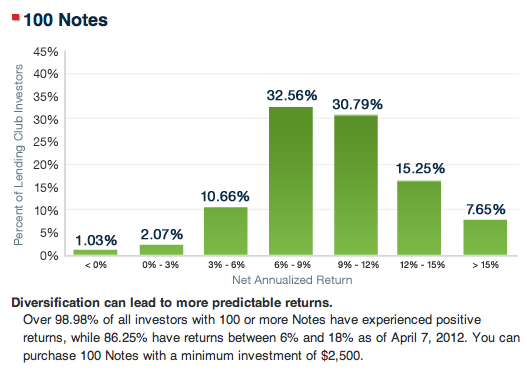
Today I was browsing Lending Club's Diversification page, looking at the graphs for 100 notes and 400 notes. Both contain a similar inaccuracy:

It seems like a minor quibble, but I certainly worry whenever I see a company where I invest money make mathematical mistakes in their marketing materials.
Today I was browsing Lending Club's Diversification page, looking at the graphs for 100 notes and 400 notes. Both contain a similar inaccuracy:
Lending Club states that "Over 98.98% of all investors with 100 or more Notes have experienced positive returns" and yet they show that 1.03% of investors have <0% returns.
It's the word "over" that is inaccurate here, and the inaccuracy comes down to a rounding issue. But "over" is a marketing word that translates to a specific mathematical meaning: greater than 98.98%. And that simply can't be true if the number of <0% returns rounded to 1.03%.
Following conventional rounding rules, the minimum percentage that the 1.03% of <0% returns could actually be is 1.025%.
Being generous with the word over, let's assume in this case that there are 98.98% positive returns.
98.98% + 1.025% = 100.005% which is, of course, impossible.
Lending Club's statement is false. Under 98.98% of all investors with 100 or ore Notes have experienced positive returns. If they want to use the word "over" they must change the value to over 98.97%.
Yes, it's small, but it's a way to demonstrate that everyone in the organization, right down to the marketing folks, really understand the importance of the numbers to us lenders and are committed getting us great returns that are mathematically sound, not ones that just sound good.
Lending Club's 400 Notes image suffers from the same issue:
Saturday, October 22, 2011
Inquiries vs. Returns
Just over a year ago Ken from lendstats.com made a graph showing Returns vs. Credit grade (among other interesting graphs.) I found this fascinating and since I read it I have started investing in listings with only small numbers of inquiries.
I wanted to see if this trend is continuing so, using lendstats' complete performance breakdown I put together the following graphs for both Prosper and Lending Club:


I wanted to see if this trend is continuing so, using lendstats' complete performance breakdown I put together the following graphs for both Prosper and Lending Club:
To me it looks like, in general, the trend is holding true. Loans with more inquiries appear to have a lower ROI than loans with fewer inquiries. There may be some bobbling at 5+ inquiries but there seems to be much more variation. Indeed, looking at these four graphs the deviation for the 0-inquiry loans is always the smallest and, as we move to more inquiries, the deviation seems to get larger and larger.
It's also nice to see, in Lending Club loans, how the 0-inquiry loans appear to gain a 1%-2% ROI each year that passes for the past 4 years. Looking at the spread between all loans and D's and below, it looks like much of that gain has come from the lower-rated loans.
Tuesday, September 6, 2011
Loan Description Length: Lending Club
In a post introducing their new Loan Analyzer, Smart Peer Lending writes that they've added a new Loan Description Length search filter:
Data Set: Lending Club loans made before the start of 2009
Let's begin by looking at the ROI results using Smart Peer Lending's Loan Analyzer:
 (Data is presented in Table Form at the end of the post under the title Lending Club ROI.)
What's interesting is that we see ROI swell in the 101-500 character description range and then drop off significantly after 500 characters--the opposite of what I'd expect. Now I take data from my personal analysis tool and find:
 (Data is presented in Table Form at the end of the post under the title Lending Club Percent Paid.)
Wow! The longer the description, the less likely a loan is to be Good (defined as Status = Paid or Current.) This is exactly the opposite of what I was expecting. I suppose that it could be that the longer a loan request is, the more the borrower feels the lender needs to be talked into funding a risky loan request.
On Thursday I'll post an analysis of data from Prosper to see if the same thing holds true with loans made over there. I'll be looking at a broader range of loans and breaking them down into higher-rated and lower-rated loans to see if those categories make a difference.
Update: There seems to be a very strong correlation between credit grade and the count of characters in the description. Details are available in my post Loan Description Length By Credit Grade.
Lending Club ROI
Lending Club Percent Paid
Loan Desc Length : One possible feature useful for selecting loans is the length of the description field entered by the borrower. Justification being that borrowers who don't take the time to enter in anything may prove to be a higher risk.I agree. It makes sense that borrowers who write longer descriptions are ones who care more about their loans and, therefore, are more likely to pay them back. Today I'll look at the data for loan description length on Lending Club and in a few days I'll look at the loan description length on Prosper.
Data Set: Lending Club loans made before the start of 2009
Let's begin by looking at the ROI results using Smart Peer Lending's Loan Analyzer:

What's interesting is that we see ROI swell in the 101-500 character description range and then drop off significantly after 500 characters--the opposite of what I'd expect. Now I take data from my personal analysis tool and find:

Wow! The longer the description, the less likely a loan is to be Good (defined as Status = Paid or Current.) This is exactly the opposite of what I was expecting. I suppose that it could be that the longer a loan request is, the more the borrower feels the lender needs to be talked into funding a risky loan request.
On Thursday I'll post an analysis of data from Prosper to see if the same thing holds true with loans made over there. I'll be looking at a broader range of loans and breaking them down into higher-rated and lower-rated loans to see if those categories make a difference.
Update: There seems to be a very strong correlation between credit grade and the count of characters in the description. Details are available in my post Loan Description Length By Credit Grade.
Lending Club ROI
| Description | Total Loans | Smart Peer Lending ROI |
| Pre 2009, All | 2998 | 0.72% |
| Pre 2009, 0-100 Character Description | 1016 | 0.83% |
| Pre 2009, 101-500 Character Description | 1353 | 1.04% |
| Pre 2009, 501 Characters And Longer | 629 | -0.16% |
Lending Club Percent Paid
| Description | Total Loans | Percent Good | Percent Bad | Fully Paid | Current | Charged Off | Default |
| Pre 2009, All | 2996 | 77.2% | 21.8% | 66.2% | 11.1% | 21.1% | .2% |
| Pre 2009, 0-100 Character Description | 1001 | 78.6% | 20.6% | 70.2% | 8.4% | 20% | .1% |
| Pre 2009, 101-500 Character Description | 1350 | 77.1% | 21.9% | 64.6% | 12.5% | 21% | .2% |
| Pre 2009, 501 Characters And Longer | 630 | 75.2% | 23.7% | 62.7% | 12.5% | 23% | .2% |
Sunday, August 28, 2011
An initial investment in Lending Club
I've been a Prosper lender for years but I've been thinking about branching out to lending on Lending Club, as well. Since I've been looking at words which have performed poorly on Prosper I wanted to extend that search to Lending Club, as well.
What follows is Lending Club data taken from about two months ago. For D, E, F and G loans we can see that the words used seem to correlate with the loans similarly on both sites:
'Need', 'help', 'behind', and 'payday' all have fewer Good loans (defined as 'Fully Paid' and 'Current') and more Bad loans (defined as 'Charged Off', 'Default', and 'Late (31-120 days)'). The only exception in the words I searched here is for the word 'Chance' which actually performed better than the average loan. (This could be true for Prosper, as well, and is worth further investigation.)
When taken as a group, the four bad words yield the following results:
So, as I start to invest, I expect that I'll only be investing in loans where the title and description does not have any of these words.
What follows is Lending Club data taken from about two months ago. For D, E, F and G loans we can see that the words used seem to correlate with the loans similarly on both sites:
| Description | Total Loans | Percent Good | Percent Bad | Fully Paid | Current | Charged Off | Default |
| D,E,F,G All | 8840 | 81.1% | 9.4% | 15.5% | 65.6% | 7.5% | .1% |
| D,E,F,G With 'need' | 1455 | 77.9% | 16.2% | 21.6% | 56.3% | 13.8% | .1% |
| D,E,F,G With 'help' | 1422 | 80.3% | 11.3% | 18.9% | 61.4% | 9.3% | .4% |
| D,E,F,G With 'chance' | 84 | 83.3% | 7.1% | 22.6% | 60.7% | 6% | 0% |
| D,E,F,G With 'behind' | 65 | 78.5% | 16.9% | 18.5% | 60% | 15.4% | 0% |
| D,E,F,G With 'payday' | 12 | 41.7% | 58.3% | 25% | 16.7% | 58.3% | 0% |
'Need', 'help', 'behind', and 'payday' all have fewer Good loans (defined as 'Fully Paid' and 'Current') and more Bad loans (defined as 'Charged Off', 'Default', and 'Late (31-120 days)'). The only exception in the words I searched here is for the word 'Chance' which actually performed better than the average loan. (This could be true for Prosper, as well, and is worth further investigation.)
When taken as a group, the four bad words yield the following results:
| Description | Total Loans | Percent Good | Percent Bad | Fully Paid | Current | Charged Off | Default |
| D,E,F,G All | 8840 | 81.1% | 9.4% | 15.5% | 65.6% | 7.5% | .1% |
| D,E,F,G without 'help', 'behind', 'need', 'payday' | 6436 | 81.8% | 7.8% | 13.8% | 68% | 6% | .1% |
So, as I start to invest, I expect that I'll only be investing in loans where the title and description does not have any of these words.
Subscribe to:
Posts (Atom)